Editing documents
The document editor provides a complete view of each document’s current version, including metadata, category assignments, and content body, allowing editors to make targeted updates and publish them efficiently.
This functionality is essential for keeping Smart Assistant’s Knowledge Base accurate and up to date.
Through this screen, you can:
- Modify titles, text, and categories of existing documents
- Adjust publication visibility or restrict access
- Manage scheduled activation and deactivation dates
- Monitor Unpublished Changes before content goes live
- Control version status and publication lifecycle
Regularly updating documents guarantees that the assistant delivers precise, consistent, and verified responses to users.
Accessing the Editor
From Document List:
- Navigate to Document List
- Click on any document title
- Editor opens with document loaded
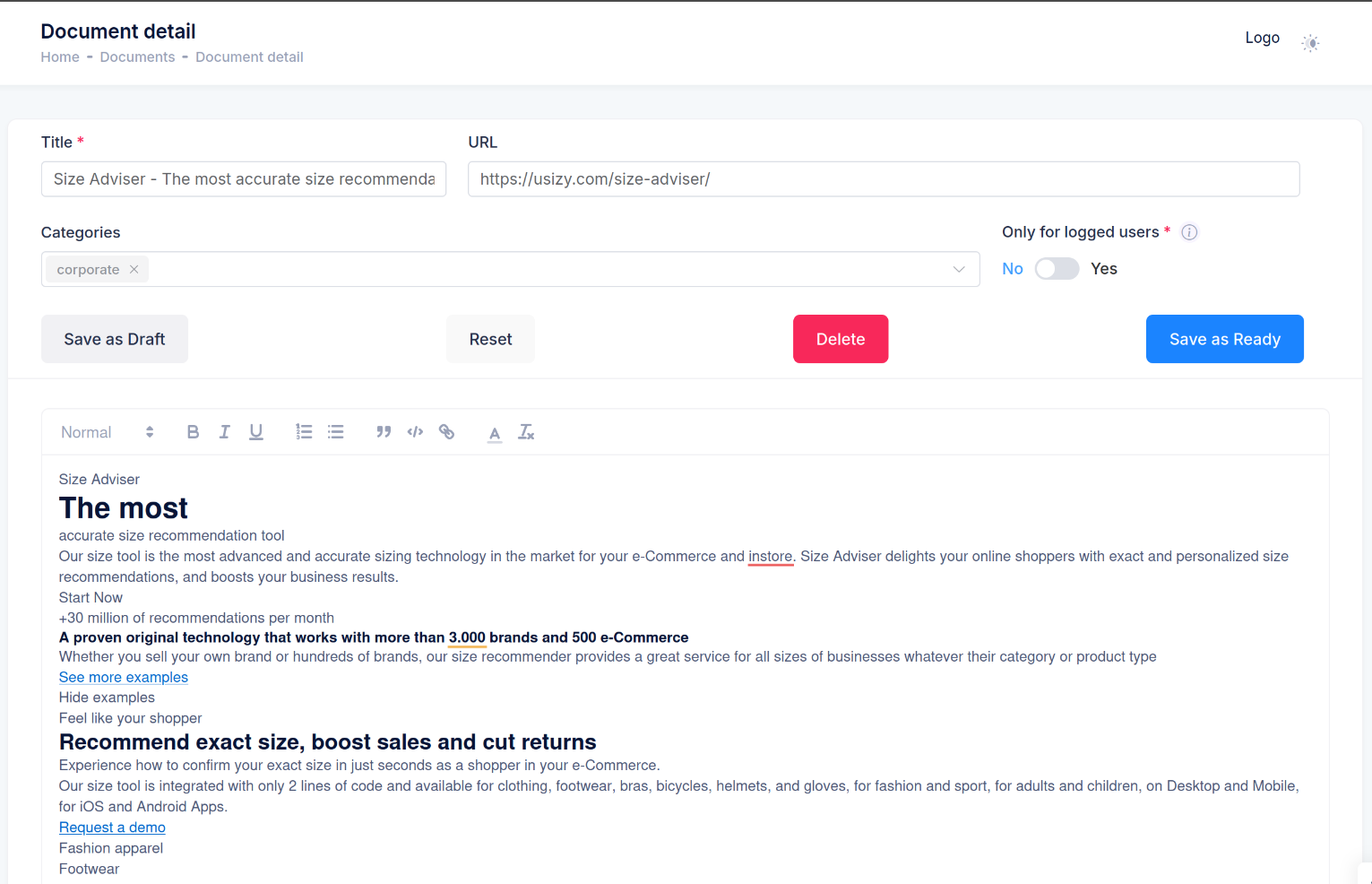
The screen displays the same editor interface as Add Document, but pre-populated with existing document data.
View/Edit Document Screen
Unpublished Changes Banner
When you modify a document and save it as Ready/Scheduled, this banner appears at the top of the screen.

Display Conditions:
- Appears when document has been modified and saved as READY
- Shows when document status changed from PUBLISHED to READY
- Persists until changes are published
- Visible across all document editor screens
Banner Actions:
Publish now:
- Immediately starts publication process for all pending changes
- Button disabled during active publication
- Shows loading spinner when publishing
- Publishes ALL documents marked as READY or SCHEDULED (not just current one)
Go to list:
- Returns to Document List
- Useful for managing multiple documents or reviewing all pending changes
Document Editor Form
The editor displays the same fields as Add Document, pre-populated with the document’s current data.
Editable Fields
All fields from Add Document are available with the same functionality:
- Title (Required) - Document name/heading
- URL (Optional) - Reference URL for source
- Categories (Optional) - Topic organization
- Activation Date (Optional) - Not editable for published documents
- Deactivation Date (Optional) - Always editable
- Content (Required) - Main document body
- Only for logged users - Access control toggle
Key Difference: Activation Date Locking
Critical Restriction: Once a document is PUBLISHED, the activation date field becomes locked (grayed out) and cannot be modified. This prevents inconsistencies in the knowledge base timeline.
The deactivation date, however, remains fully editable at all times.
Why This Restriction Exists:
The activation date locks to ensure:
- Timeline integrity of published content
- Accurate audit trails
- No retroactive changes to “go-live” dates
- Consistency for users and systems
Learn More: See Scheduled Documents - Why Activation Dates Lock for complete details.
Action Buttons
The editor provides several actions for managing document state and content.
Save as Draft
Converts the document to DRAFT status.
When to use:
- Need to make major revisions
- Content requires extensive review
- Working on updates over multiple sessions
Behavior:
- Removes from publication queue
- Does NOT trigger unpublished changes warning
- Can be edited freely without affecting production
Save as Ready
Updates the document and marks it for publication.
Status Assignment:
- READY - If no activation date or past activation date
- SCHEDULED - If future activation date is set
Behavior:
- Adds to publication queue
- Triggers unpublished changes banner
- Requires publish action to go live
- System automatically determines READY vs SCHEDULED
Learn More: See Scheduled Documents - Publication States for complete details on document states.
Reset
Discards all unsaved changes and reloads from server.
When to use:
- Made changes you want to undo
- Want to review last saved version
- Accidentally modified wrong fields
Behavior:
- Reloads original data from server
- No confirmation dialog (immediate action)
- All unsaved changes lost
- Useful safety mechanism before committing changes
Delete
Permanently removes the document from the database.
When to use:
- Content is no longer relevant
- Document was created in error
- Duplicate content needs removal
- Complete cleanup required
Behavior:
- Shows confirmation dialog before deletion
- Permanent action - cannot be undone
- Triggers unpublished changes warning
- Redirects to Document List on success
- Document removed from all knowledge bases
Common Editing Workflows
1. Updating Published Content
Scenario: Fix typo or update information in a live document.
Steps:
- Open document from Document List
- Make your changes (content, categories, etc.)
- Note: Activation date is disabled (grayed out) - cannot change
- Deactivation date is editable if needed
- Click “Save as Ready”
- Unpublished Changes banner appears
- Navigate to Document List
- Click “Publish” to make changes live
Result: Updated content goes live, maintaining original activation date.
2. Extending Content Availability
Scenario: Document has a deactivation date approaching, but content is still relevant.
Steps:
- Open the document
- Locate the Deactivation Date field
- Change to a later date (or remove entirely for indefinite availability)
- Click “Save as Ready”
- Navigate to Document List and “Publish”
Result: Document remains active beyond original deactivation date.
Learn More: See Scheduled Documents - Deactivation Flexibility for more scenarios.
3. Adding Expiration to Existing Content
Scenario: Content is currently published indefinitely, but should expire.
Steps:
- Open the published document
- Activation date is locked (can’t change)
- Set Deactivation Date to desired future date
- Click “Save as Ready”
- Publish changes
Result: Document will automatically deactivate on the specified date.
Learn More: See Scheduled Documents - Adding Expiration for detailed examples.
4. Preparing Seasonal Content Updates
Scenario: Update holiday content scheduled for next year.
Steps:
- Locate last year’s holiday document (likely UNPUBLISHED)
- Open the document
- Update content for current year
- Set new Activation Date (future date) - only if not yet published
- Update Deactivation Date (end of season)
- Click “Save as Ready” → becomes SCHEDULED
Result: Content automatically activates and deactivates on schedule.
Publication Lifecycle After Editing
Understanding what happens after you save changes:
Standard Edit Flow
- Edit published document
- Save as Ready → Status changes to READY
- Unpublished Changes banner appears
- Navigate to Document List
- Click Publish → Status returns to PUBLISHED
- Changes go live
Scheduled Edit Flow
- Edit scheduled document (not yet activated)
- Can modify activation date if not published
- Save as Ready → Status remains SCHEDULED
- Document activates automatically on activation date
Deactivation Flow
- Published document with deactivation date
- Date arrives at 00:00 UTC
- System automatically changes status to UNPUBLISHED
- Removed from active knowledge base
- No manual action required
Learn More:
- Publication System - Complete publication process details
- Scheduled Documents - State Transitions - All possible state changes
Managing Manual Changes
Documents marked as having “manual changes” in the Document List require special consideration.
Understanding Manual Changes
The “Changes?” indicator shows documents that were:
- Imported from a URL
- Then manually edited afterward
Why This Matters:
- Re-importing will overwrite your manual edits
- Need to decide: keep manual changes or re-import fresh content
Best Practices
Before Editing Imported Documents:
- Check if document was imported (URL field populated)
- Consider editing at source if possible
- Document what you changed manually
- Be aware re-importing will overwrite changes
Learn More: See Best Practices - Manual Changes for detailed guidance.
Scheduling Quick Reference
For complete scheduling information, see Scheduled Documents.
Editable When Editing
| Field | Draft | Ready | Scheduled | Published |
|---|---|---|---|---|
| Title | ✅ | ✅ | ✅ | ✅ |
| URL | ✅ | ✅ | ✅ | ✅ |
| Categories | ✅ | ✅ | ✅ | ✅ |
| Content | ✅ | ✅ | ✅ | ✅ |
| Only for logged users | ✅ | ✅ | ✅ | ✅ |
| Activation Date | ✅ | ✅ | ✅ | ❌ Locked |
| Deactivation Date | ✅ | ✅ | ✅ | ✅ |
Key Rules
- ✅ Activation date - Editable until document is published
- ✅ Deactivation date - Always editable, even for published documents
- ✅ All other fields - Always editable regardless of status
- ❌ Activation date (published) - Permanently locked
Tips for Efficient Editing
Before Editing
- ✅ Review current document status
- ✅ Check for manual changes indicator
- ✅ Note activation/deactivation dates
- ✅ Plan what needs changing
- ✅ Consider using DRAFT for major revisions
During Editing
- ✅ Use Reset if you make mistakes
- ✅ Save frequently (drafts preserve work)
- ✅ Remember activation date locks after publish
- ✅ Update deactivation dates as needed
- ✅ Review categories for relevance
After Editing
- ✅ Review changes in editor before saving
- ✅ Choose appropriate status (Draft/Ready)
- ✅ Note unpublished changes banner
- ✅ Publish promptly or coordinate with team
- ✅ Verify changes after publishing