Why do you base size recommendations on body measurements instead of product measurements?
When looking for the perfect fit, it is natural to think that comparing your body to the flat measurements of a garment is the best approach. However, relying solely on product measurements can be misleading.
To understand why, let’s look at how a single real-world tester fits into three completely different garments using the exact same size.
The Real-World Example
Consider a testing model with the following physical body measurements:
- Height: 182 cm
- Weight: 75 kg
- Chest Circumference: 97 cm
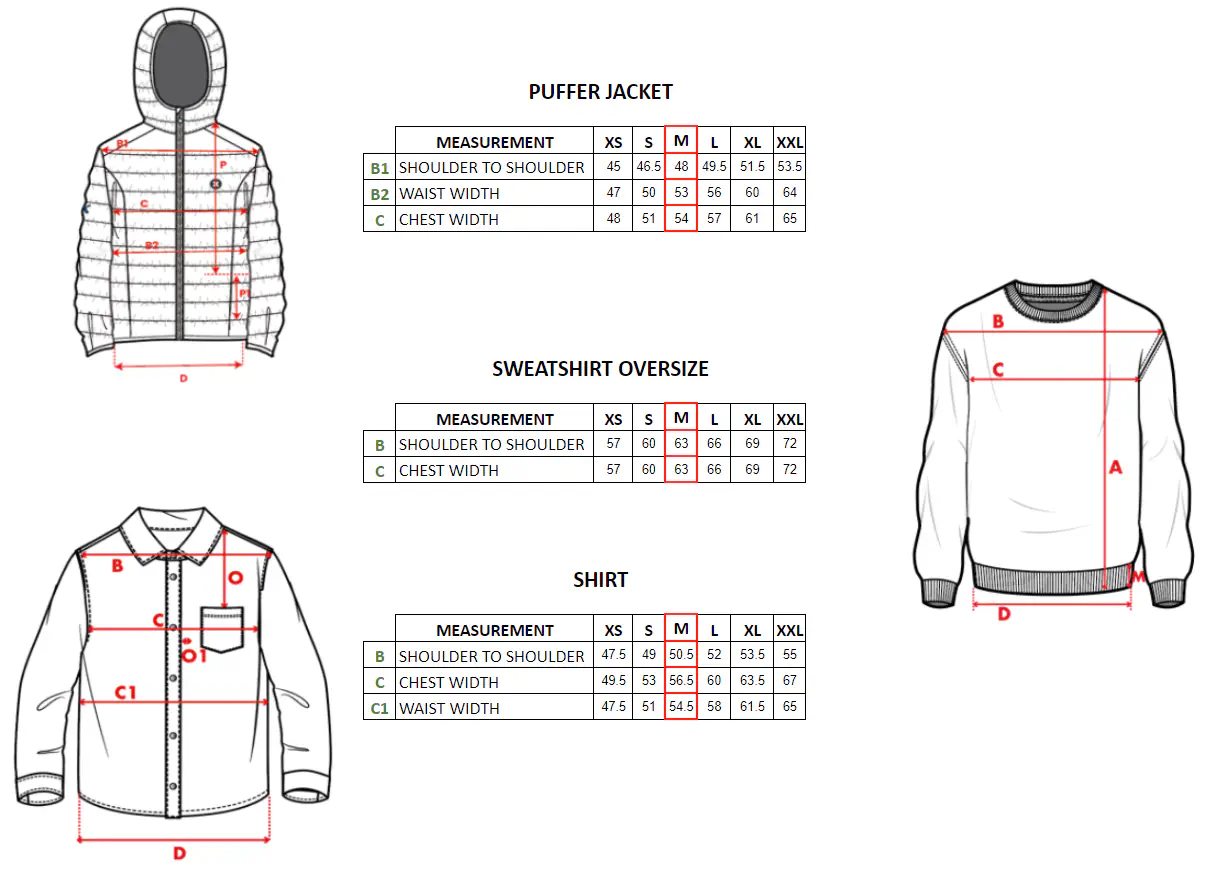
Now, let’s look at the flat product measurements for a Size M across three different items from the official size guide:
- Puffer Jacket (Chest Circumference): 108 cm
- Oversized Sweatshirt (Chest Circumference): 126 cm
- Shirt (Chest Circumference): 109 cm
The Paradox of Product Measurements
If you were to strictly compare the model’s 97 cm chest to the numbers above, you might conclude that a Size M is far too large and would not fit them in any of these items.
In reality, Size M is the correct and perfect fit for this person in all three cases.
Why Body Measurements and “Fit” Matter Most
Product measurements vary drastically from one garment to another because they account for the design, fabric thickness, and intended silhouette of the item (such as an intentional oversized look or the bulkiness of insulation in a jacket).
While the physical dimensions of the fabric change, the underlying fit category remains consistent for the person wearing it.
It is therefore impossible to know the fit of any product without trying it on to understand the body measurements limits for each size. Focus on the limits of physical body measurements ensures that regardless of whether an item is tight, regular, or oversized, you get the exact fit the designers intended.